Trainerize Water tracker

Trainerize Water tracker

Trainerize Water tracker

What is Trainerize?

What is
Trainerize?

Trainerize is a platform that helps coaches create workout routines and nutrition plans for their clients. Coaches can guide clients through fitness programs using AI-generated workouts, nutrition coaching, and a mobile app where clients can track meals, calories, water intake, activity, and progress.

Details

My role


I worked as a Senior Product Designer leading the project, in close collaboration with a Product Manager and engineering team from discovery through to rollout.

I owned the end-to-end UX work, including research synthesis, UX strategy, interaction design, and UI design. I also translated strong UserVoice demand and user insights into a clear product direction, while helping align stakeholders on a consistent interpretation of a more UI-driven experience.

Throughout the project, I worked closely with engineering on feasibility and edge cases, and iterated through regular design reviews to refine the experience leading up to a phased rollout.


Overview

The platform had strong tooling around exercise and meal planning, but no native way to track hydration. Coaches had no way to set water goals for their clients, and clients had no place to log their daily intake. This was a clear gap in the product, and one we prioritised for Q4 2025.

Problem

Before this initiative, Trainerize did not offer any native way for clients to track water intake. This created a disconnect in the coaching experience, particularly for trainers who aim to deliver holistic nutrition guidance.

Many clients relied on third-party tools such as MyFitnessPal, but hydration data was not synced within Trainerize. For users who did not use external apps, there was no structured way to track water intake at all, which often resulted in no tracking or inconsistent manual methods like notes or spreadsheets.

This limitation affected both sides of the coaching relationship. Coaches lacked visibility into a foundational health behavior that influences performance, recovery, and weight management, while clients experienced an incomplete tracking ecosystem compared to competing fitness applications where hydration tracking is standard.

From a product perspective, this gap weakened the platform’s promise of being an all-in-one coaching solution.

Before this initiative, Trainerize did not offer any native way for clients to track water intake. This created a disconnect in the coaching experience, particularly for trainers who aim to deliver holistic nutrition guidance.


Many clients relied on third-party tools such as MyFitnessPal, but hydration data was not synced within Trainerize. For users who did not use external apps, there was no structured way to track water intake at all, which often resulted in no tracking or inconsistent manual methods like notes or spreadsheets.


This limitation affected both sides of the coaching relationship. Coaches lacked visibility into a foundational health behavior that influences performance, recovery, and weight management, while clients experienced an incomplete tracking ecosystem compared to competing fitness applications where hydration tracking is standard.


From a product perspective, this gap weakened the platform’s promise of being an all-in-one coaching solution.

Before this initiative, Trainerize did not offer any native way for clients to track water intake. This created a disconnect in the coaching experience, particularly for trainers who aim to deliver holistic nutrition guidance.


Many clients relied on third-party tools such as MyFitnessPal, but hydration data was not synced within Trainerize. For users who did not use external apps, there was no structured way to track water intake at all, which often resulted in no tracking or inconsistent manual methods like notes or spreadsheets.


This limitation affected both sides of the coaching relationship. Coaches lacked visibility into a foundational health behavior that influences performance, recovery, and weight management, while clients experienced an incomplete tracking ecosystem compared to competing fitness applications where hydration tracking is standard.

From a product perspective, this gap weakened the platform’s promise of being an all-in-one coaching solution.

The Solution

The solution introduced native hydration tracking integrated into both client and coach workflows. Clients can log their daily intake through a simple entry flow, supported by a quick-add interaction that reuses their last logged value to reduce repetition and make daily logging faster.

Early in the design process, I explored multiple directions for how expressive the UI could be, ranging from more visually heavy, dashboard-like concepts to simpler, task-focused layouts. A significant part of the work was navigating differing stakeholder opinions on how “UI-driven” the experience should feel. There was strong appetite for a more visually bold interface, which required aligning expectations around what would actually support daily use versus what would add unnecessary complexity.

I intentionally pushed back on some of the more UI-heavy directions and instead focused on keeping the experience anchored in the core job to be done, which is quick and effortless logging. The final direction balanced a more modern visual treatment with simplicity, ensuring the interface felt improved and more engaging without compromising speed or clarity.

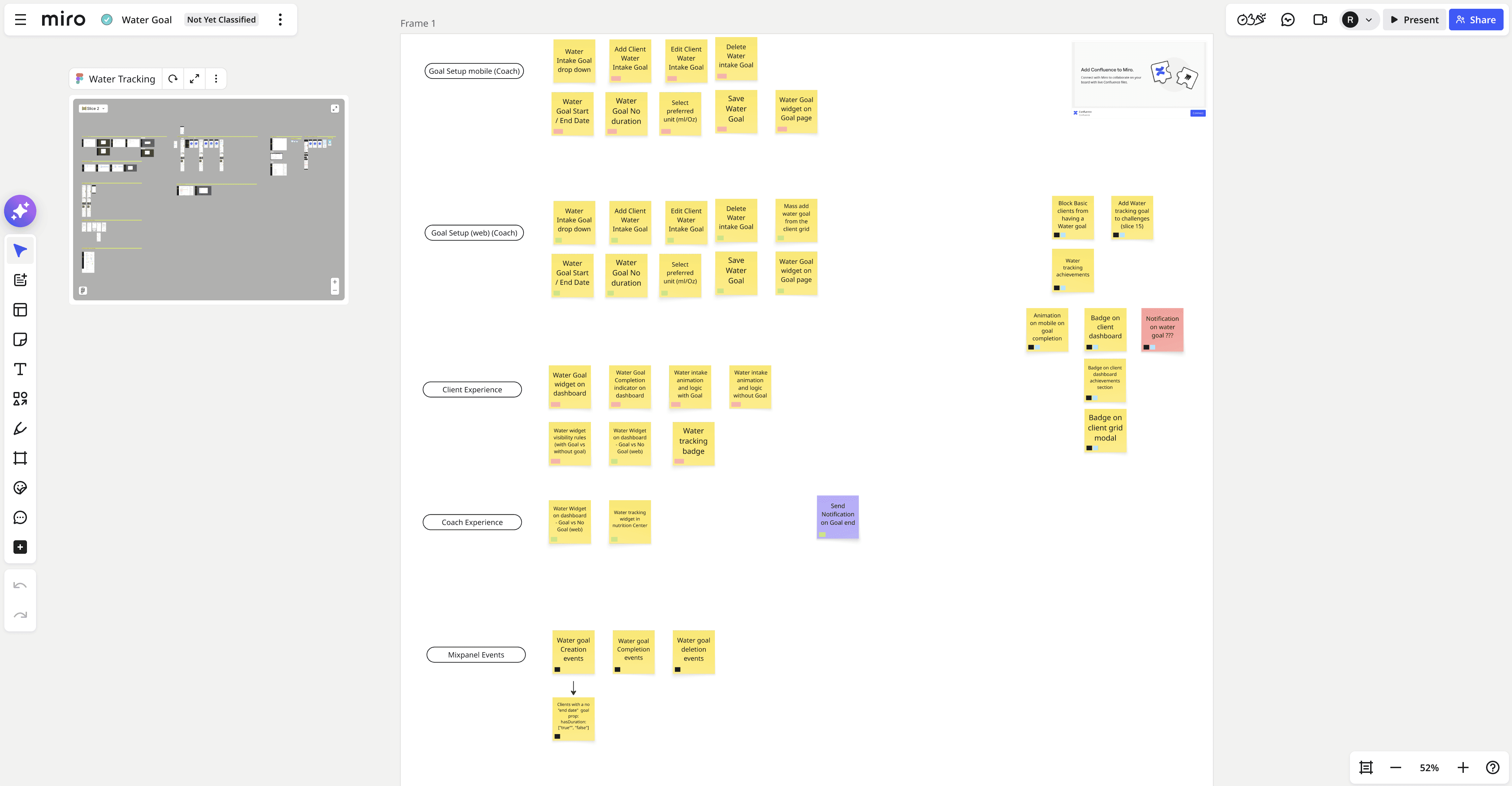
Goal setting and daily logging were intentionally separated to maintain clarity in the experience. The feature was delivered in phases using a slicing approach, starting with a controlled MVP release to validate behaviour before scaling to full rollout.

UI iterations throughout the process

Discovery

The discovery phase combined strong quantitative demand with focused qualitative research to validate the opportunity and shape the experience.

Water tracking had consistently been the most requested feature on UserVoice for several years, with hundreds of votes and comments from both coaches and clients. Competitive analysis also confirmed it as a standard expectation in leading fitness and wellness apps, reinforcing it as a clear product gap.

I conducted around 10 user interviews with coaches and clients to understand how hydration fits into real coaching workflows. Coaches consistently saw it as part of nutrition programming and wanted simple visibility into consistency, while clients often struggled to track water unless it was tightly integrated into their daily routine.

A key insight was that users were not looking for a complex solution, but for something fast, lightweight, and easy to use consistently. The focus shifted toward reducing effort and making tracking feel like a natural part of their existing routine.

Based on these findings, we defined success metrics early to align the team on expected outcomes. A key target was a 30% adoption rate of clients logging water at least once per week within the first quarter.
The Solution

The solution introduced native hydration tracking integrated into both client and coach workflows. Clients can log their daily intake through a simple entry flow, supported by a quick-add interaction that reuses their last logged value to reduce repetition and make daily logging faster.

Early in the design process, I explored multiple directions for how expressive the UI could be, ranging from more visually heavy, dashboard-like concepts to simpler, task-focused layouts. A significant part of the work was navigating differing stakeholder opinions on how “UI-driven” the experience should feel. There was strong appetite for a more visually bold interface, which required aligning expectations around what would actually support daily use versus what would add unnecessary complexity.

I intentionally pushed back on some of the more UI-heavy directions and instead focused on keeping the experience anchored in the core job to be done, which is quick and effortless logging. The final direction balanced a more modern visual treatment with simplicity, ensuring the interface felt improved and more engaging without compromising speed or clarity.

Goal setting and daily logging were intentionally separated to maintain clarity in the experience. The feature was delivered in phases using a slicing approach, starting with a controlled MVP release to validate behaviour before scaling to full rollout.

Outcome

The feature launched in Q4 2025. The following data covers the first three months post-launch, tracked via Mixpanel.

148,400 unique users logged water at least once, and the feature generated 3.09 million total tracking events in that period. The volume of events relative to unique users indicates that clients were not just trying the feature once but returning to log regularly.

6.12% of active clients tracked water within the first three months. As a baseline for a newly launched feature, this gave us a clear starting point to measure growth against. More notably, 32.09% of clients who already had a nutrition goal set were tracking water. This exceeded our initial adoption target of 30% for this segment, confirming that positioning the feature within an existing coaching workflow was the right approach.

The data also reflected something that came directly out of the discovery phase. Clients with a coach-set goal were more likely to engage with the tracker. 89,380 clients with a nutrition goal were logging water compared to 61,770 without one. The research suggested that a personal target would drive motivation to log, and the usage data supported that.

Create a free website with Framer, the website builder loved by startups, designers and agencies.